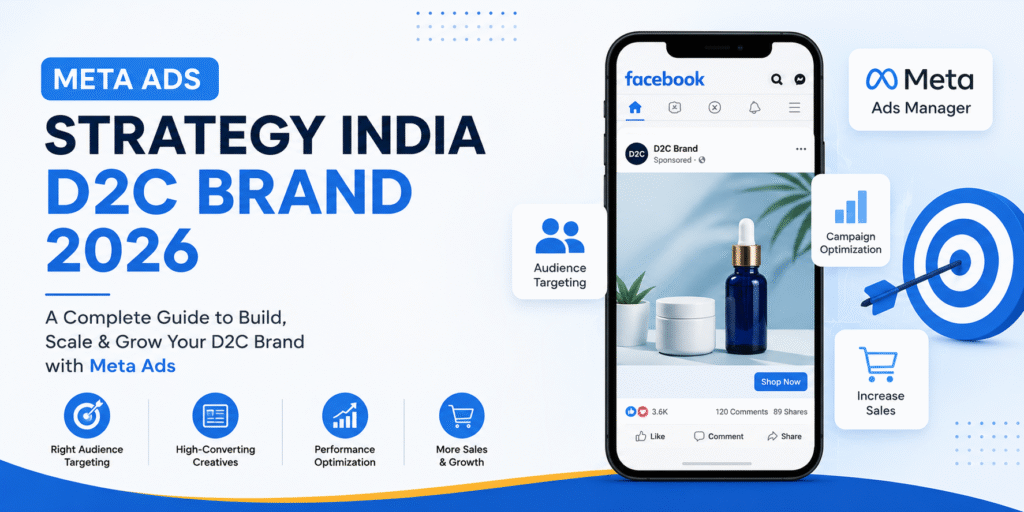
Rising CPMs have quietly broken the old Meta Ads playbook. Here’s what Indian D2C brands are actually doing differently this year to stay profitable.
40–60%
Rise in Meta CPMs since 2023
40–50%
Typical Meta budget share now (down from 80%)
2.4x–4.8x
ROAS range for mature D2C accounts
For years, the Indian D2C playbook was simple: put most of your budget into Meta Ads, run static image creatives, and scale. That approach is breaking down in 2026. Meta’s ad costs have climbed sharply, audiences have grown ad-fatigued, and brands that once scaled purely on paid acquisition are now watching their margins shrink.
But the D2C brands still growing profitably haven’t abandoned Meta — they’ve changed how they use it. Here’s what’s actually working right now.
“The brands growing sustainably in 2026 aren’t the ones spending the most on ads — they’re the ones building smarter systems around their spend.”
Trend 1: Meta's Role Has Shrunk — On Purpose
The old “80% Meta, 20% Google” budget split is largely gone. Brands are now spreading spend more deliberately across channels to reduce dependency on any single platform.
Channel
2023 Allocation
2026 Allocation
Meta (FB + Instagram)
~80%
40–50%
Google (Shopping, Search, PMax)
15–20%
25–30%
Emerging channels (organic, content, SEO, retention)
15–25%
This shift isn’t about abandoning Meta — it’s about not being fully dependent on one increasingly expensive channel.
Trend 2: Video-First, Not Static-First
What's Working
Reels-led creative for cold audiences
Brands that scaled successfully in 2026 have largely moved away from static image ads for cold prospecting. Video-led, Reels-first creative is consistently outperforming static formats for demand creation, while static images now play a smaller, more targeted role — mainly in retargeting.
What's Fading
Cold acquisition on static ads
Running cold traffic campaigns purely on static product images has become significantly less efficient, with acquisition costs on this format climbing much faster than on video creative.
Trend 3: Weekly Creative Refresh Is Now the Norm
Top-performing D2C accounts aren’t relying on one or two “hero” ads anymore. Instead, they’re running a consistent cycle of fresh creative — testing multiple angles and formats weekly to fight ad fatigue before it hurts performance.
A common testing approach among high-performing accounts is a “3×3” framework — three different messaging angles tested across three different formats — used to continuously identify what resonates before scaling budget behind the winners.
Trend 4: Cleaner Account Structures, Not Bigger Ones
Counterintuitively, the brands performing best aren’t running more campaigns — they’re running fewer, tighter ones. A typical high-performing structure looks like:
- Prospecting: 2–3 campaigns split by audience type
- Retargeting: 2 campaigns split by funnel stage (engaged vs. cart abandoners)
- Catalog/reactivation: 1–2 campaigns for repeat purchase and win-back
Within these, budget tends to concentrate heavily on the top-performing ad set rather than spreading thin across many untested variations.
Trend 5: Retention and Organic Are No Longer "Nice to Have"
With acquisition costs rising, the most resilient D2C brands are investing meaningfully in retention loops (repeat purchase campaigns, email/WhatsApp flows) and organic discovery (SEO, content, social commerce) alongside paid ads — rather than treating paid acquisition as their only growth lever.
What This Means for Smaller D2C Brands
You don’t need a ₹50-lakh ad budget to apply these shifts. For smaller and growing Indian D2C brands, the practical takeaways are:
- Prioritize video/Reels creative over static images, even with a modest budget
- Keep your account structure simple — a few clean, well-tested campaigns beat many scattered ones
- Don’t put 100% of your budget into Meta — even a small allocation toward SEO or Google can reduce risk
- Build a basic retention flow (WhatsApp or email) early, rather than relying solely on repeat ad spend to bring customers back
FAQs
Do I need paid tools to do keyword research?
Why have Meta ad costs increased so much?
Should small D2C brands still start with Meta Ads?
How often should ad creative be refreshed?
The Bottom Line
Meta Ads hasn’t stopped working for Indian D2C brands in 2026 — but the brands still winning have adapted. They’ve diversified their channel mix, shifted to video-first creative, tightened their account structures, and invested in retention alongside acquisition. For any D2C brand still running the 2022 playbook, this is the year to update the strategy.
Want a Meta Ads strategy built for how 2026 actually works?
Viser Solutions Pvt. Ltd. (Viser Digital) — Ghansoli, Navi Mumbai — helps D2C and local brands scale profitably across Meta, Google, and SEO.